Updated October 2026
Why Denver Winters Are a Bigger Risk for Landlords Than Most Realize
Denver looks mild on a calendar. It averages 300 days of sunshine a year, and many winter days feel like spring. However, Colorado’s Front Range winters are deceptive, and for rental property owners, that deception can be expensive.
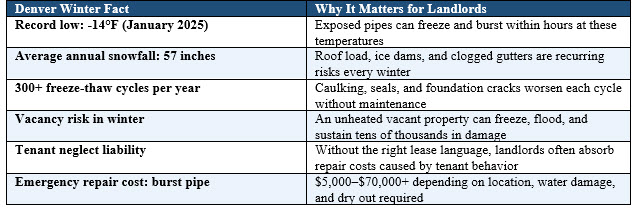
In 2025, Denver recorded a low of -14°F. Average annual snowfall is 57 inches (though 2025 came in well below at 29.8 inches — but you can’t count on that). The freeze-thaw cycles that Denver sees throughout October, November, and March are often more damaging than sustained cold, because they repeatedly stress pipes, foundations, seals, and roofing materials.
As a landlord, you carry a layer of risk that homeowners don’t.
Your property may sit vacant between tenants during the coldest months. A tenant may leave for the holidays without turning the heat down responsibly. A lease clause you didn’t include could leave you holding a $15,000 pipe-burst repair bill that should have been the tenant’s responsibility.
This guide is built specifically for Denver-area landlords and investors not generic homeowners. It covers what to do before winter hits, what to put in your lease, and what a professional property manager handles so you don’t have to. Want this as a printable checklist? Download the PDF →
Colorado Winter Risk at a Glance
Part 1: Winterizing Between Tenants (Vacant Property Protocol)
A vacant Denver rental in winter is your highest-risk scenario. No one is there to notice a dripping faucet, a furnace that stopped working, or a slow roof leak. Here’s what to do whenever your property sits empty heading into cold weather:
Heating System
- Always keep the thermostat at a minimum of 55°F. Lower than this and pipes in exterior walls are at risk
- Schedule an annual furnace inspection and tune-up before October (HVAC contractors book up fast — don’t wait until November)
- Replace filters and confirm the thermostat is functional
- If the property is vacant for an extended period, consider a smart thermostat with remote monitoring so you get alerts if the heat fails
Plumbing
- Disconnect and drain all garden hoses
- Shut off and drain outdoor hose bibs (frost-free spigots still need shutoff if temps drop to single digits)
- Blow out irrigation systems. This is a professional job and costs $75–$150, far less than a cracked manifold
- Insulate exposed pipes in garages, crawl spaces, and unheated utility areas with foam pipe insulation
- Know where the main water shutoff is and confirm it works. If a pipe does burst, fast shutoff is the difference between $3,000 and $30,000 in damage
Roof, Gutters & Exterior
- Clean gutters before the first freeze. Clogged gutters cause ice dams, which force water under shingles
- Inspect the roof for missing shingles, damaged flashing, and failing seals around vents and chimneys
- Trim tree branches within 10 feet of the roofline. A heavy wet Colorado snow can bring limbs down on a roof overnight
- Check and re-caulk around windows, doors, and any exterior penetrations
Windows, Doors & Insulation
- Test weatherstripping on all exterior doors. Drafts drive up heating costs and create moisture problems
- Inspect attic insulation. Colorado’s energy codes call for R-49 in attics; many older Denver homes fall short
- Seal any gaps around utility penetrations (gas lines, electrical, HVAC pipes) where they enter the building envelope
Fireplace & Chimney
- Schedule annual chimney inspection and cleaning. National Fire Protection Association recommends once per year
- Confirm the damper closes properly An open damper in a vacant property is like leaving a window open all winter
- Test smoke and carbon monoxide detectors and replace batteries
Part 2: Winterizing with a Tenant in Place
When a tenant is living in your property, winterization becomes a partnership. The landlord is responsible for the property being structurally sound and the heating system being functional. The tenant is responsible for using the property in a way that doesn’t cause damage. The problem: many tenants don’t know what that means in a Colorado winter.
What Landlords Must Do (Colorado Habitability Standards)
Under Colorado law, landlords must maintain properties in a habitable condition, which includes a functioning heating system capable of maintaining at least 68°F in living areas during winter months. Failure to repair a broken furnace in a timely manner can expose landlords to claims of breach of the warranty of habitability.
- Provide a working heating system before winter begins (not after the first cold snap)
- Ensure the property is weathertight (windows, doors, and the roof keep out the elements)
- Respond to emergency repair requests (burst pipe, heat failure) promptly. Colorado courts have held that landlords must respond to heat emergencies within 24–72 hours
- Give tenants written instructions on winter property care at lease signing or move-in
What to Communicate to Tenants
A one-page winter prep document given to every tenant at move-in or in October reduces your risk and gives you documentation if a dispute arises. Include:
- Minimum thermostat setting: 65°F when home, no lower than 55°F when away or traveling
- What to do if pipes freeze: call immediately, locate the main shutoff, do not use open flame to thaw pipes
- How to report a heating failure. Provide your emergency maintenance line
- How to operate the fireplace and what is prohibited (green wood, trash, oversized fires)
- Sprinkler system and hose bib shutoff: confirm tenants know these must be done before first freeze
- Gutter and downspout responsibility. Typically the landlord’s, but tenants should report blockages
Part 3: The Lease Clauses That Protect You
This is the section most landlords skip, and the one that costs them most. Without explicit lease language, Colorado courts often split the blame (and the costs) on disputed repair claims. These clauses won’t make you bulletproof, but they create a clear record of the standard of care expected.
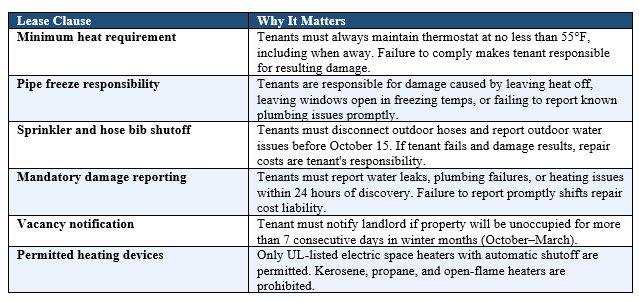
Important: Lease clauses must comply with Colorado landlord-tenant law. Have any new lease language reviewed by a Colorado real estate attorney before use.
Part 4: What a Professional Property Manager Handles for You
Managing a rental property through a Colorado winter involves ongoing tasks that are easy to miss if you’re self-managing, especially if you don’t live near the property. Here’s what a professional property manager like Colorado Realty and Property Management does proactively every fall and winter:
- Every managed property receives a documented inspection covering roof, gutters, HVAC, plumbing, weather sealing, and safety equipment before the heating season.
- We schedule and oversee sprinkler blowouts, furnace inspections, chimney sweeps, and gutter cleaning using vetted contractors at volume pricing.
- Tenants in all managed properties receive a written winter prep notice each October with specific instructions and emergency contact information.
- Pipe bursts and heat failures don’t happen during business hours. Our emergency line is staffed around the clock so problems are handled before they escalate.
- For vacant properties, we conduct periodic checks during cold snaps and can arrange for smart thermostats with remote alerts.
- We maintain inspection records and maintenance logs that support insurance claims when weather damage does occur.
Your Complete Denver Rental Property Winterization Checklist
Use this as your annual fall checklist.
Exterior & Roof
- Gutters cleaned and downspouts clear
- Roof inspected for missing shingles, damaged flashing, failing chimney seals
- Tree branches trimmed to 10 feet from roofline
- Foundation inspected for cracks, gaps, or rodent entry points
- Exterior caulking checked and refreshed around windows, doors, and penetrations
Plumbing
- Garden hoses disconnected and stored
- Outdoor hose bibs shut off and drained
- Irrigation system professionally blown out
- Exposed pipes in garage/crawlspace insulated
- Main water shutoff confirmed working and location documented
Heating & HVAC
- Annual furnace/boiler inspection and tune-up completed
- HVAC filters replaced
- Thermostat tested and confirmed functional
- Minimum temperature set to 55°F for vacant periods
- Smart thermostat/remote monitoring installed if property will be vacant
Windows, Doors & Insulation
- Weatherstripping on all exterior doors checked and replaced as needed
- Window seals inspected — re-caulk any gaps
- Attic insulation level assessed (R-49 recommended for Colorado)
- Utility penetrations sealed
Fireplace & Safety
- Annual chimney inspection and cleaning completed
- Fireplace damper confirmed functional
- Smoke detectors tested, batteries replaced
- Carbon monoxide detectors tested, batteries replaced
Tenant/Lease Items
- Winter prep notice sent to all tenants
- Lease reviewed for minimum heat, pipe freeze, and vacancy notification clauses
- Emergency maintenance line confirmed for tenants
Frequently Asked Questions
Who is responsible if pipes freeze in my Denver rental — me or the tenant?
It depends on what caused the freeze and what your lease says. If the furnace failed, that’s typically the landlord’s responsibility. If the tenant turned the heat off or left for two weeks without notifying you, that’s typically the tenant’s responsibility but only if your lease clearly states the minimum heat requirement and the tenant’s duty to notify you of extended absences. Without those clauses, you may share the cost even if the tenant’s behavior caused the problem.
When should I schedule a furnace inspection in Denver?
August or September. HVAC contractors in Denver are fully booked by late October. If you wait until you notice a problem, you may not get an appointment before the first hard freeze. Annual inspections typically cost $80–$150 and can catch issues that would otherwise mean an emergency call which runs $300–$600 or more.
Do I need to winterize even if my Denver rental has tenants?
Yes. Tenant occupancy doesn’t eliminate your responsibility to maintain the property. You should still schedule annual HVAC and chimney inspections, inspect gutters and the roof, and send tenants a winter prep notice with clear instructions. Occupancy reduces, but doesn’t eliminate, the risk of vacancy-related damage.
What temperature should I keep a vacant Denver rental in winter?
Minimum 55°F. This is the threshold below which pipes in exterior walls are at serious risk of freezing, especially in the Denver metro where temperatures can drop into the single digits overnight. For added protection, leave cabinet doors under sinks open to allow warm air to reach supply lines.
How much does it cost to winterize a rental property in Denver?
Routine annual winterization such as furnace tune-up, sprinkler blowout, gutter cleaning, chimney inspection typically runs $400–$700 for a single-family rental in the Denver area. That’s a fraction of what a single burst pipe costs: basic water damage remediation starts at $5,000 and can easily reach $20,000–$50,000 when you factor in dryout, drywall, flooring, and mold remediation. Use this checklist every fall. Download the printable PDF version →
Can my property manager handle winterization for me?
Yes, and this is one of the clearest ROI arguments for professional management. A good property manager coordinates all annual maintenance, documents it, communicates with tenants, and responds to winter emergencies 24/7. Colorado Realty and Property Management handles this for all managed properties across the Denver metro area.
Protect Your Investment This Winter
Colorado Realty and Property Management has managed Denver-area rental properties for over 20 years. Our owners don’t spend their winters chasing furnace technicians, fielding tenant calls about frozen pipes, or wondering whether the gutters got cleaned. We handle the inspections, coordinate the vendors, communicate with tenants, and respond to emergencies around the clock, so the property runs the way it should and the landlord doesn’t have to think about it.
If you’d like to know what your rental property could earn under professional management, start with a free rental estimate.
Sources
• National Weather Service Denver: Annual Weather Summary 2025 — weather.gov/bou
• Steadily: Landlord’s Checklist for Winterizing Rental Properties — steadily.com
• Colorado Revised Statutes § 38-12-503: Landlord Habitability Standards
• National Fire Protection Association: Chimney and Fireplace Safety — nfpa.org


